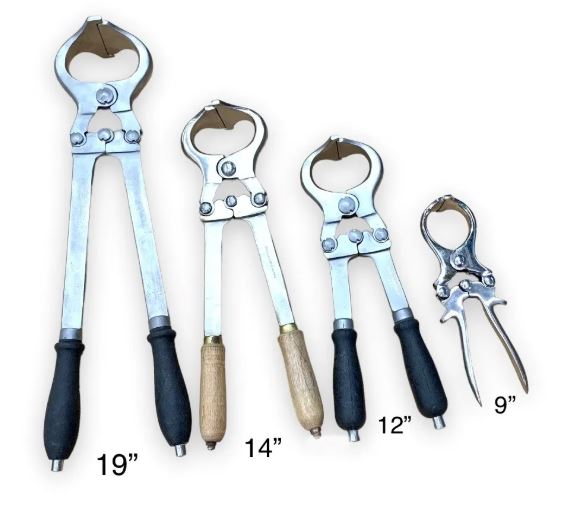
Castration forceps of different sizes are readily available at Jaakai Surgical, a premier manufacturer known for supplying high-quality veterinary instruments. These forceps, predominantly recognized under the Burdizzo style, are specifically engineered for bloodless, non-surgical castration in livestock. This technique relies on a highly focused, heavy-duty mechanical force to crush the spermatic cord and blood vessels leading to the testicles. By interrupting the blood supply without cutting open the outer scrotal skin, the testicular tissues naturally atrophy and reabsorb. This process minimizes blood loss, mitigates infection risks, and eliminates post-operative open-wound complications.
Technical Specifications and Material Quality
To ensure longevity, durability, and reliable clinical execution, the instruments at Jaakai Surgical follow stringent manufacturing rules:
Sizing and Animal Applications
Sizing dictates mechanical leverage and tool dimensions. It must be carefully matched to the anatomy of the target livestock to protect patient health.
Size / Length
| Size / Length | Target Livestock Application | Clinical Rationale & Leverage |
| 23 cm (approx. 9 inches) | Young piglets, lambs, kids, and small pets. | Requires lighter pressure; smaller jaw size ensures precise clamping on narrow cords. |
| 30 cm (approx. 12 inches) | Growing calves, mature rams, sheep, and larger pigs. | Mid-tier size providing moderate, balanced handle grip force for adolescent livestock. |
| 35–36 cm (approx. 14 inches) | Heavy young bulls, colts, and larger sheep breeds. | Extended handles give better leverage to safely compress tougher tissues. |
| 40–47 cm (approx. 16–18 inches) | Fully mature bulls, large cattle, and adult stallions. | Longest design providing max leverage needed to crush dense, thick spermatic cords safely. |
Operational Features & Safeguards
The castration forceps from Jaakai Surgical are designed with integrated safety features. Many styles come equipped with a built-in cord-stop device. This prevents the spermatic cord from slipping out of the jaws during maximum compression.
When executing the procedure, operators clamp one spermatic cord at a time rather than bridging both simultaneously. This leaves a clear, uncrushed space in the central scrotal tissue partition. This critical step ensures that continuous blood supply is maintained to the surrounding scrotum tissue. It prevents localized tissue necrosis or gangrene, making the bloodless method highly efficient, predictable, and humane.